Thursday, 19 July 2012

Berlin: Day 1

On my first day at the University of Arts Berlin Archive I was given an introduction to the collections, the history of the institution, and Archives in Berlin in general. An important function of the Archive is to preserve the history of the University and its preceding institutions. It was established in 1975 in what was then West Berlin after the College of Fine Arts and the Academy of Music and Performing Arts, both founded in the latter part of the 19th century, were merged. The four colleges specialise in fine arts, architecture, music, performing arts and media and design. The Archive represents these disciplines, as well as holding modern and historical administrative records. The roots of the Arts University can be traced back more than 300 years to the foundation of the Brandenburg-Prussian Academy of Arts in 1696, but the collections from the College of Fine Arts and the Academy of Music and Performing Arts make up a much larger part of the Archive.

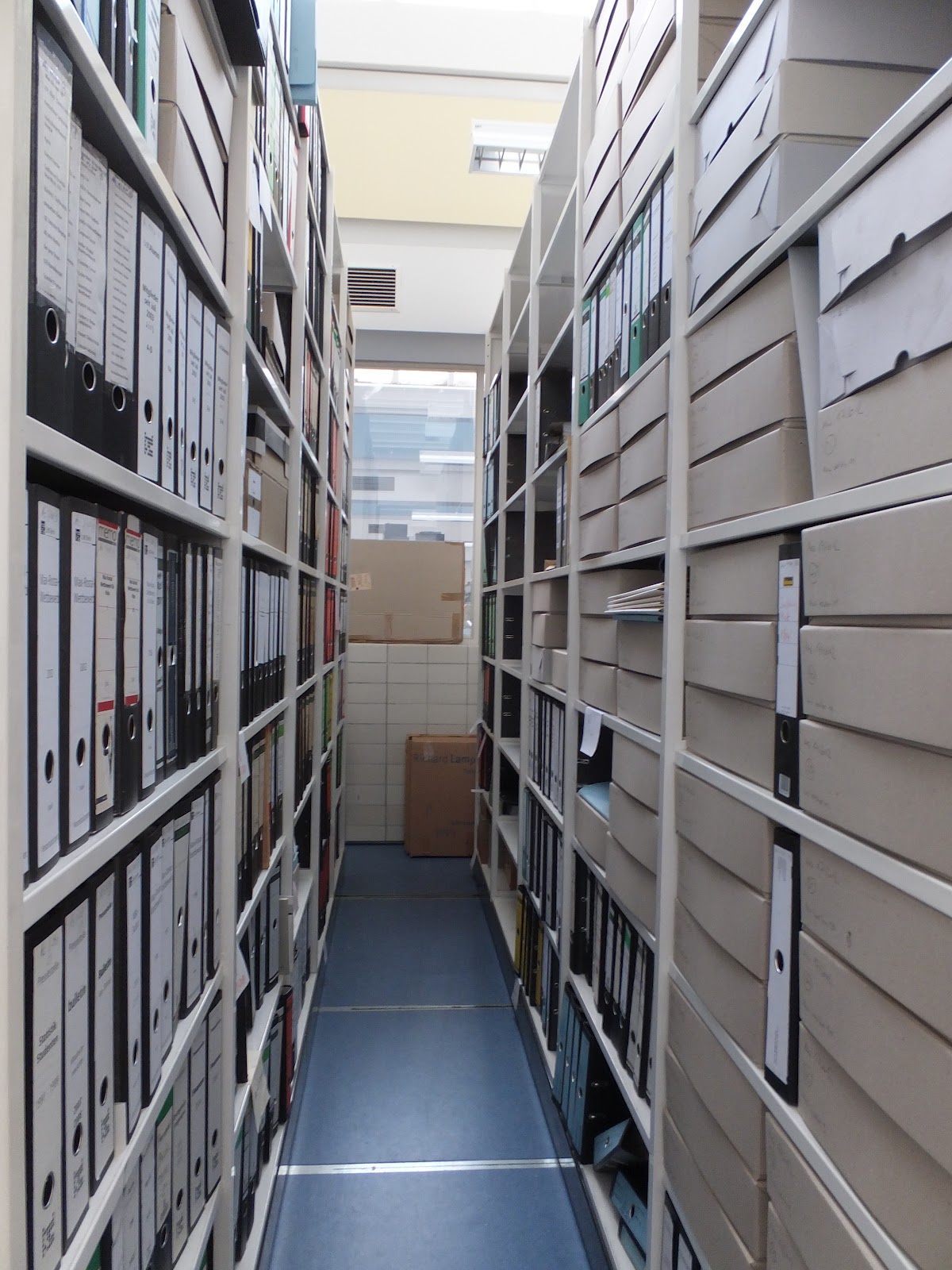
University of the Arts Berlin Archive Store
© Mary Allen

The Archive collects the archives of individuals, particularly those who have had a close relationship with the University, such as lecturers. One of the most important collections is that of Karl Blossfeldt, an important photographer and sculptor best known for his close-up photographs of plants in the early 20th century. He taught sculpture at the Royal Museum of Decorative Arts and later the United State School for Fine and Applied Arts between 1899 and 1930, both predecessors of the present-day University. A database has been created so that all the images held by the University Archive can be viewed on-line, which can be found here - well worth a look!

Like our Archive Service, the University Archive in Berlin takes in collections that are connected to the subjects studied at the University that are of research value to the students. Unlike us, however, they are responsible for administrative records of a semi-current nature, such as student records. These are requested frequently by offices within the University and since they are not yet archival there is no issue around their controlled access. While our collections are used often by our students for inspiration, particularly the Ian Stern photographic collection and our Cornish Performance Archives, the archives at the University in Berlin are almost only used for research purposes.


Some semi-current files in the Archive store
© Mary Allen
One fundamental difference between the British and German systems is the existence of Archive Law in Germany. Each state has its own law which applies to the State Archives and the archives of any other public body in the State, such as University Archives. The Berlin Public Records Act (Archivgesetzes des Landes Berlin) was passed in November 1993 and sets out legislation on the preservation and use of Archives in the State of Berlin. Some clauses are particularly interesting:
  • Section 3 provides a definitition of archives as documents of value, for example deeds, acts, personal papers, audio and visual material, maps, files. Archival material is that which is worth being preserved and is necessary for research, education, and understanding of the past and present.
  • Section 4 states that all authorities, courts and agencies of the State are required to get rid of all documents that are no longer needed, usually 30 years after its creation, unless there are other laws to determine deadlines. Construction records, for example, are usually kept for 90 years.
  • Section 7 says that the State Archive must ensure the orderly and proper permanent storage of archival material.
  • Section 8 says that records relating to an individual can only be disclosed to 3rd parties with the consent of the individual concerned. After the death of an individual, a further 10 years must elapse before the records can be used, with the consent of relatives. If the date of death is unknown, the protection period is 90 years after birth and if the date of birth is not known the protection period is 70 years after the document was created.
So after having my mind boggled with all this very interesting legislation on my first morning, I was able to have a slightly less strenuous afternoon at the University Library.

University Library
© Mary Allen
The Library is shared by the University of the Arts Berlin and the Technical University and is absolutely vast! The Library covers all the subjects offered by both institutions. The University of the Arts Library, due to its long and varied history, has a comprehensive collection of old stock, which makes up the Rare Book section. I was taken to see the Rare Books, which are kept in a secure room. The majority are German but there are also many English books - I spotted a shelf full of Thomas Hardy! There are also many original music manuscripts.

The Library opened in 2004 and is amazingly high-tech - it even has conveyor belts to move books around between floors and the machines for returning books sort them all by themselves! It became obvious looking round that these things were necessary for the running of the Library, which is so big and has such a large capacity - without such technology the library staff would be completely overwhelmed. It's a fantastic building and a great place to study, with works of art on each floor for inspiration. There is a media centre where videos, DVDs and CDs can be viewd or listened to and also a digital piano where students can try out music scores.

So at the end of my first day I felt I'd already learnt quite a lot! And I was really looking forward to what the rest of the week would bring...


University of the Arts Berlin

My internship has so far offered me some fantastic training opportunities and visits, but perhaps none more exciting than my placement last week, which saw me fly off to Berlin to spend five days at the Archive Service at the University of the Arts Berlin. This was all arranged through Erasmus - being able to take part in schemes like this is one of the great things about working for an HE Archive. The aim of the placement was to gain practical experience and knowledge of archive administration in a comparable HE Service in another European country. I was really excited about seeing what kind of collections they held and how they compared to ours and learn what the archivists there did day-to-day. Berlin has been at the top of my list of places to visit for a while, so obviously this added an extra bit of excitement! So off I went armed with camera, notebook and guidebook. Find out what I saw and learnt as I post my daily diary...


The University of the Arts Berlin
©Mary Allen

Thursday, 28 June 2012

St Ives Archive

Yesterday I vistited the volunteer-run community archive at St Ives. Having worked with a number of volunteers at our Archive and Special Collections Service at Tremough, I have become very interested in how archive services can use volunteers - in ways that are both beneficial to the service as well as the individual.

The St Ives Archive was set up in 1996 and has been collecting material on the town ever since, particularly newspaper articles, legal documents, pamphlets, tourist quides, sound recordings, photographs and genealogical records. The main subjects covered are maritime, art, family history, buildings, photographs, archaeology and public services. Each volunteer has an area of expertise, and many have a vast knowledge of St Ives. Some have even written books using the Archive, and these are on sale as a form of generating funds.You could tell that each person working there had a real love for St Ives and its community, and I was amazed at the wealth of information available.

It's not an archive in a strict sense of the word - they don't work around the rules and regulations that we might do, over handling care for example, and a lot of the information isn't primary sources. Their material isn't catalogued as we would catalogue ours, but information is kept in subjects. Around the walls are hundreds of files, each on a different topic. These files are each colour coded, to tell you which of the main catagory they fall into. This makes it all very user-friendly - a reader can browse through a folder as they like and can look at material on the spot, without necessarily having to make an appointment. So although it isn't an archive in the sense that we might see it, it certainly is a mine of information, and very accessible information at that. And afterall, I think that is what a Community Archive should offer. It was amazing to see how well organised they are, and how well they have managed on nothing but donations, membership and occasional funding for projects. It really was an inspirational visit, and I would be very interested to learn how other Community Archives work - possible dissertation topic for next year?!

Tuesday, 26 June 2012

A Cornish giant and some positive feedback

Being based partly in an arts university, we often get readers in the archive looking at our collections for a vast array of reasons. As well as the more traditional researchers, we also get students looking for inspiration. Last week we had an MA Professional Writing student, along with her illustrator, who are creating an illustrated children's book on Cornish Folklore. We have fantastic resources for this - not only the Special Collections of Cornish Poetry and the Gorseth Kernow collection in the library which contain many illustrated books of Cornish tales, but there is also a wealth of material in the Kneehigh Archive.

Kneehigh have taken many folktales and re-worked them, and the one we focussed on was the tale of Tregeagle, which they have performed three times in 1985-6, 1989, and 1996. Tregeagle is the tale of a greedy steward, whose ghost is summoned to answer to a charge of unpaid rent and is then forced to carry out a series of pointless tasks to avoid being sent down to hell. There is a mine of material relating to the performances in the archive, from promotional material like flyers and programmes, to photograph albums and scrap books, and all are incredibly stimulating visually, which is perfect for someone researching for an illustrated children's book.

It was fantastic to receive from our readers some really positive feedback the next day, saying that the visit had left them "feeling inspired and motivated to get writing and drawing". This is what's great about our Performance Archives - they can be used in a less traditional ways to inspire creativity, and this has definitely been a theme amongst students coming in to use our service, and not only with the Performance archives but also the photographic Ian Stern Archive. We can't wait to see the result of the visit and look forward to sparking the creative juices of many more students to come!

Wednesday, 30 May 2012

Volunteer Tea Party

This Monday was a very exciting day for us in the Archives, with the launch of our Twitter (which we are all now totally addicted to) and a tea party in honour of all our fantastic volunteers in the afternoon. With the promise of tea and cake and some very special guest speakers it was set to be a fantastic afternoon, and it didn't disappoint. We were joined by some of our brilliant student volunteers and members of staff who've all done their bit over the last few years. Our speakers were Sarah Riddle, Collections Curator at the National Maritime Museum Cornwall, and Lynne, a volunteer who has been working on an amazing collection of photos at the Museum.

 
© Archives & Special Collections Service at
University College Falmouth & Univsersity of Exeter's Cornwall Campus

We really value the help from our volunteers, and it was great to hear from Sarah how valued they are in much larger institutions - in fact the National Maritime Museum is largley run by volunteers, from researchers to boat-builders, marketing assistants to conservators. For me, the highlight was listening to Lynne talk so enthusiastically about her project to catalogue a collection of photographs donated to the Museum by David Weller. The 600-odd photos were taken by Weller and his father and provide a unique photographic history of the Falmouth docks. Although the photos came with a meticulous index, Lynne was able to use her local knowledge to add even more detail. One of the photographs, a beautiful image of a ship called Waterwitch, was chosen to be February's 'Curator's Choice', and can be seen here.

It was fantastic to see a volunteer so dedicated to her work. Here at the Tremough Archives we have had some amazingly dedicated volunteers of our own, with three having committed over a hundred hours to the Service each! So for them there was a short award ceremony with certificates, not laminated, but housed safely in archival sleeves...


© Archives & Special Collections Service at
University College Falmouth & Univsersity of Exeter's Cornwall Campus

 Next week is National Volunteers Week. We should all celebrate the contribution that volunteers make in terms of time, expertise, and enthusiasm (and all that for free!), not only in Archive Services, but across all sectors.

Tuesday, 29 May 2012

We are Tweeting!

Yesterday the Archives and Special Collections Service very proudly launched its very own Twitter. We've been busily working away on our Twitter Project and are now ready, with especial thanks to our student volunteers.

Follow us @FXArchives for tweets about our exciting collections, behind the scenes snippets, and anything and everything about archives.

UPDATE: we've had a retweet from Chris Evans!

Wednesday, 23 May 2012

Cornwall, 1952


With the Queen's Diamond Jubilee coming up in a couple of weeks, I decided to have a look through our archive and find out what was going on in 1952 in Cornwall using our collections. Since many of our collections are more modern, like the Cornish Performance Archives, most of the focus fell onto the Camborne School of Mines, the Institute of Cornish Studies, Falmouth School of Art, and painter and former principle of the Falmouth School of Art, Tom Cross.
In 1952, the Cornish political party Mebyon Kernow (Sons of Cornwall) had been going for just over a year, having been set up in January 1951. It was at this time a pressure group and contained activists and politicians from a number of political parties. Its aims were
  • To promote and foster the Cornish language and literature,
  • To study local conditions and attempt to remedy any that may be prejudicial to the best   interests of Cornwall by the creation of public opinion or other means,
  • To encourage the study of Cornish history from a Cornish point of view,
  • By self-knowledge to further the acceptance of the idea of the Celtic character of Cornwall, one of the six Celtic nations.
The Cornish language had died out in about 1800, but in 1952 the recent years had seen a revival of interest. The Cornish Gorsedh (Cornish Assembly) had been set up 23 years before, an organisation dedicated to the preservation of Cornwall's Celtic spirit, through literature, language, music and the arts, and the recognition of all forms of important service to Cornwall and its people. The most accomplished writer in the Cornish language of the day was Robert Morton Nance, who was also the Grand Bard of the Cornish Gorsedh in 1952. He wrote several plays in Cornish, textbooks on the language, and developed a unified spelling for Cornish. 


The Cornish Review, 1952 Vol 10

Richard Gendall, a leading expert in the Cornish language, wrote an article about Cornish Nationalism in Denys Val Baker's Cornish Review, 1952: “In recent years, and especially within the last year, there have appeared in Cornish newspapers and magazines a number of articles, letters, and reports with a savour of nationalism about them.” A major source of complaint was that Cornish mines were being neglected while those abroad received millions of pounds in subsidies, and that Cornish mines were prevented from achieving prosperity by crippling systems of taxation. There seemed to be two sides to Cornish nationalism in 1952: one sentimental, the other practical. "Sentimentally Cornwall is seen as a member of the Celtic family, with a past of battles against the Saxons, and rebellions against a changing world under the Tudors; a land whose Cornish language was not long ago to be heard and which even now is being cherished by a few devotees… Practically, Cornwall is seen as a small area with a great variety of resources, with a decreasing population already deprived of much of its best manhood by emigration due to economic necessity…”

During the Second World War nearly all crafts except purely rural ones came to a standstill and there was a real danger of British craftsmanship suffering a mortal blow. Thankfully, this was averted, and in the aftermath of war there was actually a revival of interest in crafts, and nowhere was this more apparent than in Cornwall. According to a survey by the Rural Industries Bureau, there were in 1952 more than 400 separate crafts in existence in the county, from the painting of sea-shells and the making of jewellery and decorations from pebbles to the more traditional – the blacksmith, wheelwright, saddler, and potter (H. Trevor, 1952. 'Crafts From Cornwall’, D V Baker (ed.) The Cornish Review). 


Pottery was an art specifically associated with Cornwall - not surprising since the county was the home of the china clay industry. Bernard Leach, Britain’s leading potter, had set up his large co-operative pottery in St Ives in 1920, to which students and visitors from all over the world visited and in 1952 was still producing not only exquisite craft work for the luxury market, but a large amount of utility goods and slipware. Cornish pottery was in wide use in Cornwall itself and all over the world. Between the end of the war and 1952 over 400 applications had been received by the Leach Pottery by people who wanted to study the craft. At this time mechanisation and mass-production was overtaking and displacing local handicrafts. In protest, people were turning back to work which “springs from the heart and gives form to the human imagination” (Bernard Leach, My Work as a Potter).

Post-war Cornwall saw a remarkable flowering of the arts and literature. Barbara Hepworth and Ben Nicholson were spearheading the Modernist movement in Britain in sculpture and painting respectively. Abstract artist Terry Frost was appointed as Hepworth's assistant in 1951 and would go on to become an important artist in his own right. Other influential Cornish artists in 1952 include: Patrick Heron, Peter Lanyon, Bryan Pearce and Bryan Wynter. (FCP3/D)


CSM Magazine, 1952 Vol 52
Although mining in Cornwall at this time was in decline, Camborne engineers were held in high regards in various parts of the world. The report from the Camborne School of Mines annual school dinner in 1952 reveals some anxiety amongst students about the situation in South Africa. Since mining was in decline in Cornwall, many went on to work abroad after finishing at the School. The National Party with its policy of Apartheid had come into power only 4 years before in 1948. “The second and third years have heard much of South Africa from representatives of mining companies there, but it is doubtful if they have had their prejudices against the country so severely shaken as by Mr. Haggart’s speech.” (Mr. Haggart being Deputy Chairman of the Anglo-American Corporation of South Africa, Ltd.) He calmed the dinner attendees about the political activities going on in SA by pointing out that “South Africa is a relatively happy country, and that the alarm in England over the racial future of the country can be settled in a sensible manner”! This particular dinner ended in a brawl, after which some went home, and others went for a swim at Gwithian: “I suppose you don’t feel the cold if you’ve had the right spirit.” (CSM Magazine, 1952)

Meanwhile, the Camborne School of Mines (CSM) Club had been given a makeover with new curtains, pelmet boards, and central heating installed. It was now being patronized by many more members of the School, and sometimes they even condescended to let women up to the Club bar! The first time this happened was apparently before the Autumn Term dance (1951), and a great success it was: “You can’t get old so and so to put his hand in his pocket to buy you a half, but you just wait until his latest girlfriend says she’ll have a double gin and lime; up he trots, meak as a lamb, and slaps down his 3/8; oh yes; very good for business.”


Falmouth School of Art prospectus, 1952

Over in Falmouth, the School of Art was still relatively small. Having been founded in 1902 on Arwenack Avenue, the School had relocated in 1950 to Kerris Vean, Woodlane. Numbers of students were incredibly small compared with what it is today (University College Falmouth), with only 23 full-time! And, compared to the £9000 a year students will be expected to pay from next year, fees were much cheaper in 1952 at £25 a year, or £8.6.8 a term. The six members of teaching staff taught, among other subjects, Lettering & Illumination, Leatherwork, Dressmaking, Embroidery, and Pottery. Classes were aimed at preparing students for the Ministry of Education’s Intermediate Examination in Arts and Crafts, the National diploma in Design, and the Royal College of Art Entrance examination, with the School also providing part-time day and evening classes for those who worked or those who had a general interested in art.

60 years ago the Camborne School of Mines and Falmouth School of Art were very separate institutions. Could they have predicted then that at the time of the Queen's Diamond Jubilee they would be sharing the same campus? Probably not. Of course, Tremough did not exist at this time, and the idea of Combined Universities in Cornwall had not even been conceived. But despite sharing a campus, both have maintained their strong identities: CSM as one of the World’s most famous mining schools, and University College Falmouth as a vibrant and forward-thinking specialist arts college.

The Cornish Gorsedh is growing ever stronger, with 496 Bards at present. It continues to maintain the national Celtic spirit of Cornwall and annually awards Bardships to individuals who have provided outstanding service to Cornish culture. The highlight of the year is the Open Gorsedh, involving a procession of Bards, dressed in their blue robes, to a location of cultural significance where new Bards are initiated. Mebyon Kernow is now a recognised political party, fighting for Cornwall, a nation with its own distinct identity, language and heritage, to have the same right of self-determination as Wales and Scotland, and is leading a campaign for the self-government of Cornwall.

More information on the history of Cornwall, the Camborne School of Mines and Falmouth Art School can be found in our archive.