Tuesday, 29 May 2012

We are Tweeting!

Yesterday the Archives and Special Collections Service very proudly launched its very own Twitter. We've been busily working away on our Twitter Project and are now ready, with especial thanks to our student volunteers.

Follow us @FXArchives for tweets about our exciting collections, behind the scenes snippets, and anything and everything about archives.

UPDATE: we've had a retweet from Chris Evans!

Wednesday, 23 May 2012

Cornwall, 1952


With the Queen's Diamond Jubilee coming up in a couple of weeks, I decided to have a look through our archive and find out what was going on in 1952 in Cornwall using our collections. Since many of our collections are more modern, like the Cornish Performance Archives, most of the focus fell onto the Camborne School of Mines, the Institute of Cornish Studies, Falmouth School of Art, and painter and former principle of the Falmouth School of Art, Tom Cross.
In 1952, the Cornish political party Mebyon Kernow (Sons of Cornwall) had been going for just over a year, having been set up in January 1951. It was at this time a pressure group and contained activists and politicians from a number of political parties. Its aims were
  • To promote and foster the Cornish language and literature,
  • To study local conditions and attempt to remedy any that may be prejudicial to the best   interests of Cornwall by the creation of public opinion or other means,
  • To encourage the study of Cornish history from a Cornish point of view,
  • By self-knowledge to further the acceptance of the idea of the Celtic character of Cornwall, one of the six Celtic nations.
The Cornish language had died out in about 1800, but in 1952 the recent years had seen a revival of interest. The Cornish Gorsedh (Cornish Assembly) had been set up 23 years before, an organisation dedicated to the preservation of Cornwall's Celtic spirit, through literature, language, music and the arts, and the recognition of all forms of important service to Cornwall and its people. The most accomplished writer in the Cornish language of the day was Robert Morton Nance, who was also the Grand Bard of the Cornish Gorsedh in 1952. He wrote several plays in Cornish, textbooks on the language, and developed a unified spelling for Cornish. 


The Cornish Review, 1952 Vol 10

Richard Gendall, a leading expert in the Cornish language, wrote an article about Cornish Nationalism in Denys Val Baker's Cornish Review, 1952: “In recent years, and especially within the last year, there have appeared in Cornish newspapers and magazines a number of articles, letters, and reports with a savour of nationalism about them.” A major source of complaint was that Cornish mines were being neglected while those abroad received millions of pounds in subsidies, and that Cornish mines were prevented from achieving prosperity by crippling systems of taxation. There seemed to be two sides to Cornish nationalism in 1952: one sentimental, the other practical. "Sentimentally Cornwall is seen as a member of the Celtic family, with a past of battles against the Saxons, and rebellions against a changing world under the Tudors; a land whose Cornish language was not long ago to be heard and which even now is being cherished by a few devotees… Practically, Cornwall is seen as a small area with a great variety of resources, with a decreasing population already deprived of much of its best manhood by emigration due to economic necessity…”

During the Second World War nearly all crafts except purely rural ones came to a standstill and there was a real danger of British craftsmanship suffering a mortal blow. Thankfully, this was averted, and in the aftermath of war there was actually a revival of interest in crafts, and nowhere was this more apparent than in Cornwall. According to a survey by the Rural Industries Bureau, there were in 1952 more than 400 separate crafts in existence in the county, from the painting of sea-shells and the making of jewellery and decorations from pebbles to the more traditional – the blacksmith, wheelwright, saddler, and potter (H. Trevor, 1952. 'Crafts From Cornwall’, D V Baker (ed.) The Cornish Review). 


Pottery was an art specifically associated with Cornwall - not surprising since the county was the home of the china clay industry. Bernard Leach, Britain’s leading potter, had set up his large co-operative pottery in St Ives in 1920, to which students and visitors from all over the world visited and in 1952 was still producing not only exquisite craft work for the luxury market, but a large amount of utility goods and slipware. Cornish pottery was in wide use in Cornwall itself and all over the world. Between the end of the war and 1952 over 400 applications had been received by the Leach Pottery by people who wanted to study the craft. At this time mechanisation and mass-production was overtaking and displacing local handicrafts. In protest, people were turning back to work which “springs from the heart and gives form to the human imagination” (Bernard Leach, My Work as a Potter).

Post-war Cornwall saw a remarkable flowering of the arts and literature. Barbara Hepworth and Ben Nicholson were spearheading the Modernist movement in Britain in sculpture and painting respectively. Abstract artist Terry Frost was appointed as Hepworth's assistant in 1951 and would go on to become an important artist in his own right. Other influential Cornish artists in 1952 include: Patrick Heron, Peter Lanyon, Bryan Pearce and Bryan Wynter. (FCP3/D)
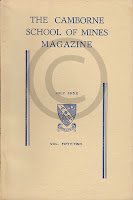

CSM Magazine, 1952 Vol 52
Although mining in Cornwall at this time was in decline, Camborne engineers were held in high regards in various parts of the world. The report from the Camborne School of Mines annual school dinner in 1952 reveals some anxiety amongst students about the situation in South Africa. Since mining was in decline in Cornwall, many went on to work abroad after finishing at the School. The National Party with its policy of Apartheid had come into power only 4 years before in 1948. “The second and third years have heard much of South Africa from representatives of mining companies there, but it is doubtful if they have had their prejudices against the country so severely shaken as by Mr. Haggart’s speech.” (Mr. Haggart being Deputy Chairman of the Anglo-American Corporation of South Africa, Ltd.) He calmed the dinner attendees about the political activities going on in SA by pointing out that “South Africa is a relatively happy country, and that the alarm in England over the racial future of the country can be settled in a sensible manner”! This particular dinner ended in a brawl, after which some went home, and others went for a swim at Gwithian: “I suppose you don’t feel the cold if you’ve had the right spirit.” (CSM Magazine, 1952)

Meanwhile, the Camborne School of Mines (CSM) Club had been given a makeover with new curtains, pelmet boards, and central heating installed. It was now being patronized by many more members of the School, and sometimes they even condescended to let women up to the Club bar! The first time this happened was apparently before the Autumn Term dance (1951), and a great success it was: “You can’t get old so and so to put his hand in his pocket to buy you a half, but you just wait until his latest girlfriend says she’ll have a double gin and lime; up he trots, meak as a lamb, and slaps down his 3/8; oh yes; very good for business.”


Falmouth School of Art prospectus, 1952

Over in Falmouth, the School of Art was still relatively small. Having been founded in 1902 on Arwenack Avenue, the School had relocated in 1950 to Kerris Vean, Woodlane. Numbers of students were incredibly small compared with what it is today (University College Falmouth), with only 23 full-time! And, compared to the £9000 a year students will be expected to pay from next year, fees were much cheaper in 1952 at £25 a year, or £8.6.8 a term. The six members of teaching staff taught, among other subjects, Lettering & Illumination, Leatherwork, Dressmaking, Embroidery, and Pottery. Classes were aimed at preparing students for the Ministry of Education’s Intermediate Examination in Arts and Crafts, the National diploma in Design, and the Royal College of Art Entrance examination, with the School also providing part-time day and evening classes for those who worked or those who had a general interested in art.

60 years ago the Camborne School of Mines and Falmouth School of Art were very separate institutions. Could they have predicted then that at the time of the Queen's Diamond Jubilee they would be sharing the same campus? Probably not. Of course, Tremough did not exist at this time, and the idea of Combined Universities in Cornwall had not even been conceived. But despite sharing a campus, both have maintained their strong identities: CSM as one of the World’s most famous mining schools, and University College Falmouth as a vibrant and forward-thinking specialist arts college.

The Cornish Gorsedh is growing ever stronger, with 496 Bards at present. It continues to maintain the national Celtic spirit of Cornwall and annually awards Bardships to individuals who have provided outstanding service to Cornish culture. The highlight of the year is the Open Gorsedh, involving a procession of Bards, dressed in their blue robes, to a location of cultural significance where new Bards are initiated. Mebyon Kernow is now a recognised political party, fighting for Cornwall, a nation with its own distinct identity, language and heritage, to have the same right of self-determination as Wales and Scotland, and is leading a campaign for the self-government of Cornwall.

More information on the history of Cornwall, the Camborne School of Mines and Falmouth Art School can be found in our archive.

Friday, 11 May 2012

Volunteers

Over the last few weeks we have been very busy in the office with several work experience and volunteer placements. It's been great to see so many students interested in what we do and wanting to come and have a go themselves! Often coming from creative disciplines, it has been quite eye-opening for us to see how they react to our collections and sometimes end up using them for inspiration. We try to match their tasks to their interests, so for example we have one regular volunteer, a Fine Art MA student, with a particular interest in photography who we have given a repackagaing project on the Ian Stern Archive. Ian Stern was an important photographer in the '60s and '70s, and the Archive contains negatives, prints, manuscripts and a fascinating range of darkroom experiments. The project has been a great success and she has begun to really get to grips with the collection, which is excellent for us as we have very little information about this particular archive. We regularly use the Ian Stern material so having it repackaged will make it much more accessible for users, and much safer to use from a preservation point of view.

Another success has been our Twitter Project. The Archive and Special Collections Service is aiming to launch its very own Twitter in the next few weeks and we have had some excellent work experience students in to research our collections for tweets. We gave a film student free reign over the vast array of books relating to film and film history in the Bill Douglas and Peter Jewell Collection and found some amusing quotes from filmstars. We've also had a history student, looking particularly at public history, who uncovered some rather interesting events in the history of University College Falmouth from local newspaper articles... So keep a look out for the launch of our new Twitter to find out more!

In the meantime, we've got a couple more volunteers and placements lined up and I'm vey much looking forward to seeing how they get on and what they come up with.

Wednesday, 9 May 2012

The Aura of Archives...

Last week Sarah and I attended a lecture given by Kym Martindale, senior lecturer in Creative Writing here at University College Falmouth. The talk began with an explanation of the library Dewey system, which differs vastly from the tree structure we use when arranging archives. An interesting point was that, technically, you could give any scene a Dewey number. For example, a tractor in a field you could say was agricultural, european, of the 21st century, and possibly more to come up with a Dewey number.

The crux of the lecture, however, was how an archive makes you feel: why are people so drawn to the archive? In some ways, rifling through an archive is a way of getting into the life and mind of someone you might admire or are researching. Currently on display at the Emory University are the Salman Rushdie archives. This contains traditional archival material such as journals, notebooks, photographs and other manuscripts, but there was also the dilemma of what to do with the vast quantity of Rushdie's born-digital records. Common options for dealing with such data can be to either preserve the physical objects: computers, floppy disks, DVDs etc, or to transfer the data to more modern systems and making sure these are kept up to date. At the Rushdie archive they have come up with an innovative way of displaying the born-digital material by giving users access to Rushdie's computer using an emulator and, in effect, simulating the author's electronic universe, thus providing an archive that is both interactive and digitally preserved. A video demonstration can be seen here.

Users are faced with a facsimile of Rushdie's computer screen from one of his early Mac computers and can navigate through his files and folders and even launch apps. No doubt this is a fascinating experience and you can totally emerse yourself in Rushdie's way of working. This simulator not only provides the information, but also gives the information an aura - an archive experience on a higher, almost spiritual, level. However, an important point was raised by an audience member during the lecture: surely the information on the computer was in some way vetted by Rushdie himself before being made public. Therefore the idea that this simulator shows his computer just as he would have used it is a false one. This made me think about archives in general: we tend to think of them as absolute truth; they are as primary as a primary source can get. But in actual fact, an archive is really only a selection. If someone uses an archive to gain a sense of someone or something, i.e. its 'aura', rather than the straightforward, non-subjective facts and evidence that it might provide, is this aura or sense in some way false?

On the other hand, you might be able to find out more about a person by using their archive. Kym spoke about the archive of poet Frnaces Bellerby, which is held at the University of Exeter. After going through the archive, Kym was suprised to see several notebooks about Bellerby's pet tortoises. These notes were so extensive, yet no mention of these tortoises had ever made it into her poetry! They were obviously a significant part of her life, yet anyone reading only her published work would never know this aspect of her life. This is an example of how using an archive can give a further dimension to the person you are researching, making them seem that little bit more real and less remote.

In any case, the idea of an archive having an 'aura' is an interesting one, and I don't think anyone who has used an archive or works in one can deny that there is a sense of satisfaction and significance in working with this original material.

Tuesday, 17 April 2012

World Book Night

World Bok Night is coming up on the 23rd of April. To celebrate, Library staff at Tremough will be giving away FREE copies of books! On this literary theme, I have been busy putting together a display to promote our Patrick Gale archive, which will be up tomorrow in the group study area of the library and will contain handwritten drafts of novels, a fillm treatment, and other exciting treats.

For those of you unfamiliar with Patrick Gale, he is best known as an author, and flew to fame when his novel Notes From an Exhibition was selected for the Richard and Judy Book Club in 2008.Yet he has also written a film, scripts for television sitcoms, and many articles and reviews for newspapers and magazines. All of these are represented in the Archive, and you can browse the catalogue here.

If you are on campus, come and have a look at my display!

Cornish Archive Network

Yesterday, Sarah and I attended a Cornish Archive Network (CAN) meeting, which meets four times a year, at the Cornwall Records Office in Truro. This was a great introduction to the various teams across the County. Those who attended were from a range of organisations: community, voluntary and professional, and most of the meeting was taken up discussing the progress of each organisation, updates and opportunities. Being new to the meetings, this was a good way to hear about what everyone does. I was particularly interested in the St Ives Archive, which is largely volunteer-run and had had an exhibition on about living in St Ives in the 1930s, focusing particularly on children and whether they were happier then or now. This had been put together by an A-Level work experience student and all in the space of a week!

We reported on the progress of all the building work and movings-around at Tremough and how that might affect the Archive Service in the future, as well as the progress on our Preservation Assessment Survey, with the sampling almost finished. Sarah also mentioned how much we'd grown since she had last attended, having gained a trainee (me!) and a part-time term-time Assistant, Carole.

Many there were part of the 'Cornwall's Sporting Histories' series of events and exhibitions giong on throughout the year, which has been organised by CAN and the Cornwall Museums Group to raise awareness of the many fantastic collections of sports-related documents all over the county. There will be displays at sports centres and Cornish Mining World Heritage sites across Cornwall, and in the Heritage Pavillion at the Royal Cornwall Show.

We have some lovely colourful leaflets with more details in the Archive office, so please come and take one!

Tuesday, 3 April 2012

A week in London

Last week I travelled up to London just in time for the beautifully hot and sunny weather to attend three days of training in Russell Square with the Archive-Skills Consultancy Ltd, which is aimed at providing basic and relevant training in archives and records management, and spent a fourth day at the archives of the Institute of Education.

The first session of training was an introduction to basic archive skills and covered several topics:
  • what are Archives?
  • collecting policies and accessioning
  • appraisal
  • providing access to Archives
We also had talks from two guest-speakers. Mark Pomeroy, Archivist at the Royal Academy, spoke about archival processing, arrangement and description; and Jonathan Rhys-Lewis, a Consultant in Preservation & Collection Management, spoke about preservation.

The second day was all about archival description and arrangement, which provided us all with a really in-depth introduction to description techniques. Both days involved facilitated discussions and exercises, which was great as it gave us the opportunity to network with the other people on the course, who were in similar situations but worked in a variety of different services. It was also reassuring that most of what was covered on the first two days I found familiar - which is a good sign that my traineeship and previous volunteer experience has been worthwhile and is setting me in the right direction!

I was most intrigued about the last day, which was an introduction to Records Management, since this is an area I have had practically no experience of and have always been a bit scared of! All the reading I did on RM before my MA interview was largely theoretical and seemed rather abstract, but this day provided a really practical overview of it and went through the realities of a Records Manager's job day-to-day, and I'm feeling much more confident about the RM module on the course.

The next day I went on a visit to the Institute of Education archives, who are in the process of taking over Records Management within the organisation. Since there's not been a proactive policy in place before, I was talked through how they were going to apply records managament from the back end, so to speak, and put plans into place for the future. I was given some appraisal work to have a go at as well. This I found a bit nerve wracking - having worked in archives for the past year I'm used to dealing with records selected for permanent preservation, so putting whole files in bags for shredding felt totally wrong! But very satisfying. I always enjoy visiting archives and seeing how they compare to others I've experienced, and this visit was particuarly apropriate as the RM aspect complemented the training I'd had the day before.

So it was a pretty full-on week, and I felt like I'd essentially had the whole Archives and Records Management MA taught to me in the space of four days, but I would totally recommend the Archive Skills Consultancy courses to anyone in a traineeship position like me or to anyone wanting a refresher. It's a really laid back environment, with lots of opportunity for networking and meeting like-minded people.